
What Are A levels? A Parent's Guide to the British Sixth Form Pathway
When children reach the age of 15–16, many parents begin to ask important questions about the educational journey ahead: What will they study next? Which programme best suits their child's abilities, interests and plans, and can genuinely open doors to leading universities?
This article is based on official admissions data from UCAS and discussions with Mr Kieran McLaughlin, the Founding Head of School of King’s College Wimbledon HCMC. As well as explaining what A levels are, we want to help you understand why the pathway matters and how your child can prepare for it.
09 Jul 2026
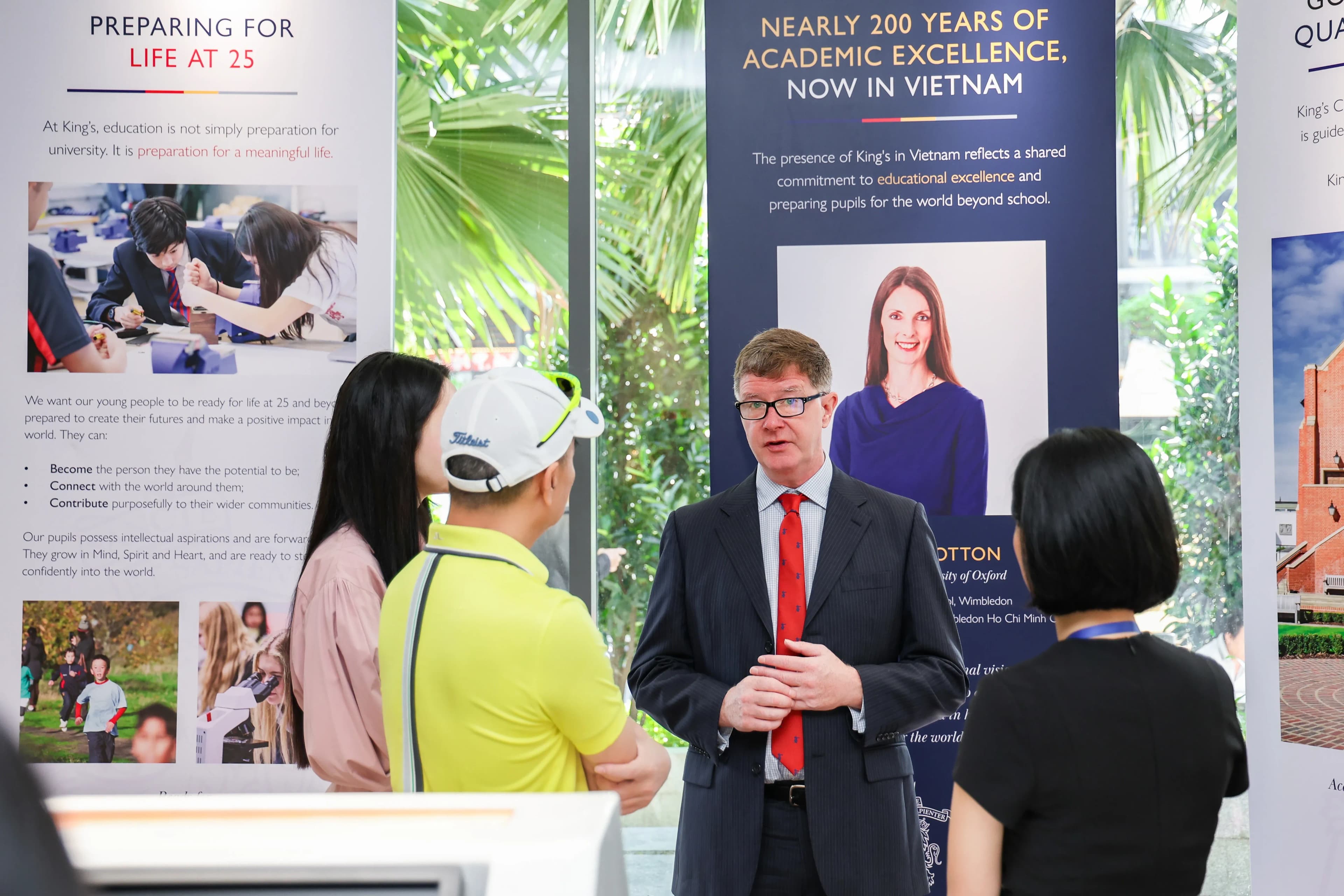
A levels, short for Advanced Level, are the qualifications taken by pupils aged 16 to 18 in the British system. This is the final stage of schooling before university, often called Sixth Form (Years 12-13), equivalent to grades 11 and 12 in the Vietnamese education system.
A levels are organised by leading international examination boards such as Cambridge Assessment International Education (Cambridge International) and Edexcel. According to official statistics from Cambridge International, Cambridge programmes are offered in over 10,000 schools across 160 countries, serving nearly 2 million learners each year. Between 2020 and 2025, global Cambridge exam entries rose by 74% - a sign of the growing confidence international families place in the British pathway.
What sets A levels apart is their philosophy: rather than studying a wide spread of subjects, pupils choose 3-4 and study them in real depth. The aim is not to cram for exams, but to understand and master each subject.
How are A levels different from IGCSE?
In the British curriculum, A levels do not stand alone; they are the final step in a connected pathway:
- IGCSE (Years 10-11): Pupils study a broad range of 5-9 subjects to build a strong academic foundation. This is the stage where parents often hear the term "IGCSE" - an essential stepping stone before Sixth Form.
- A levels (Years 12-13): Pupils narrow to 3-4 subjects that match their intended path, studying each with analytical thinking and independent research.
If IGCSE opens the door to international academic thinking, A levels are the springboard into leading universities.
Understanding the A levels pathway helps parents plan ahead and support their child through this important stage.
Study Time and Program Structure
A levels span 2 academic years:
- Year 12 is the foundation year: at some schools, pupils take the AS level (Advanced Subsidiary), a shorter version of A levels, to build their knowledge and confirm their subjects. At others, pupils begin the full A levels programme from the start.
- Year 13 is the final year: pupils sit the A levels examinations, and these results shape their university applications.
Assessment is not limited to final exams. Depending on the subject and exam board, pupils may also be assessed through extended essays, practical work or independent research (coursework). A levels test genuine thinking, not just memory.
How many subjects do pupils choose in A levels?
Parents often worry: "If they only study 3-4 subjects, is that too few?" In fact, this is one of the strengths of A levels. With the right choices, your child is not stretched across too many subjects and can put their full energy into what matters most for their future.
Here are some popular subject combination suggestions based on career orientations:

A pupil who is still deciding can choose "keystone" subjects such as Mathematics, English or the Sciences, which keep a wide range of degree options open.
Many parents ask: "Why choose A levels over other programmes?" The answer is that A levels develop how a pupil thinks, and the confidence to think independently - exactly what leading universities look for.
Globally recognised and the official admissions language
Oxford, Cambridge, Imperial College London, UCL, the University of Melbourne and thousands of other universities set clear A levels grade requirements in their entry criteria.
According to official data from UCAS (Universities and Colleges Admissions Service - the UK university admissions body), schools in the Russell Group, the 24 leading research universities in the UK, treat A levels and the IB Diploma as equal in value. What matters is a pupil's results and ability.
Real figures from Oxbridge
In the 2024 admissions cycle, Oxford University received applications from over 23,000 candidates with an offer rate of 16.4%; Cambridge University received over 22,000 applications with a rate of 21.5%. These are highly competitive figures, and A levels are the qualification most successful applicants use to gain their place.
Depth over breadth
Studying 3-4 subjects in depth means pupils arrive at university with a strong grounding in their field. Many say they do not have to start from scratch in first year, because A levels have already taught them to study in depth.
Developing analytical and independent thinking
A levels ask not just "what?" but "why?", "what is the evidence?" and "what if this view is wrong?" Pupils learn to build sound arguments, weigh different views and carry out independent research - skills that matter at university and in working life.
The 2025 A levels results at King’s College School, Wimbledon (data from kcs.org.uk) were as follows:
IGCSE / GCSE
- 98.2% of grades achieved 9-7 (equivalent to A*/A)
A levels
- 96% of grades achieved A-B*
- 54% of grades achieved A*
University
- Approximately 25% of pupils each year receive offers from Oxford, Cambridge, and Ivy League schools.
- 97% of pupils go on to leading universities.
King's College School, Wimbledon is ranked as the leading co-educational day school in the UK (Sunday Times Parent Power 2026) and Top 5 best schools in the world according to the HSBC Hurun Education Global High Schools 2025 rankings, an assessment based on official exam results, top university matriculation rates, academic reputation, and teaching quality. The same standard is being brought to King's College Wimbledon HCMC.
Getting into a good university is only the first step; what matters more is that your child has the confidence to thrive and be happy in the years ahead.
Preparation for A levels does not begin in Sixth Form; it begins with how a child studies during their IGCSE years. The parent's role here is not to manage results, but to support and encourage.
What foundation do pupils need before entering A levels?
Pupils usually complete IGCSE (Years 10-11) with a grade C or above (grade 5 on the 9-1 scale) in the subjects they wish to continue at A levels. This is the minimum requirement.
More important than grades, though, are habits of independent study, good time management and the confidence to ask questions. A levels demand far more of these than IGCSE.
With the support of King’s College School, Wimbledon, the academic team in Ho Chi Minh City works directly with pupils and parents from the end of the IGCSE year to agree the right direction and choose the A levels subjects that suit each pupil, rather than a one-size-fits-all list.
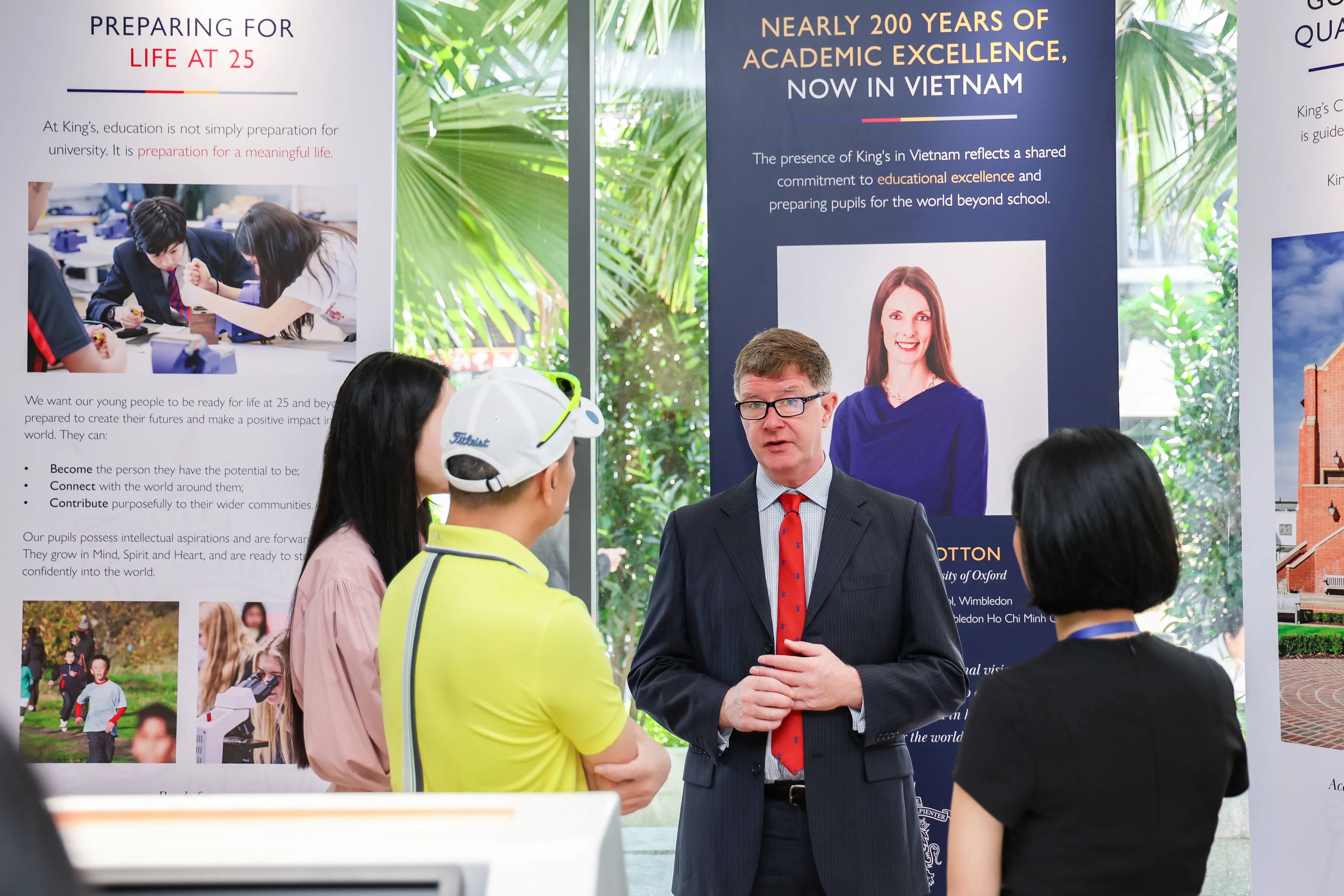
Mr Kieran McLaughlin advising parents about the A levels pathway
Frequently asked questions from parents about A levels
Below are the most common concerns we receive from parents:
How many subjects does my child need to study to get into university?
According to UCAS guidelines, for most UK universities and many international universities, three A levels are enough to apply. Some universities and courses (such as Medicine, or certain courses at Oxbridge) may ask for four. Our team will help your family plan this early.
A levels or IB - which is better?
This is the most common question. The honest answer: neither is "better" in absolute terms. UCAS data shows that leading UK universities treat A levels and the IB Diploma as equal in value. A levels suit pupils who want to go deep into fewer subjects; the IB suits those who prefer breadth. What matters is choosing the programme that fits your child's learning style and goals.
What if my child doesn't know what major they want to study yet?
This is very common and perfectly normal. Choosing "open" subjects such as Mathematics, the Sciences or English keeps a wide range of degrees available while your child explores where their interests lie.
Returning to the original question: What are A levels? We want you to remember something simpler than any academic definition:
A levels are two years in which a young person really learns to think - to go deep, to hold their ground under difficult questions, and to trust their own ability.
They are more than a ticket to university; they are a foundation for life. With nearly 2 million learners a year across more than 160 countries choosing the Cambridge pathway, and universities as competitive as Oxford (which admits only 16.4% of applicants) accepting A levels as a standard entry qualification, this is a pathway proven over time.
If your child is on the British curriculum pathway from IGCSE to Sixth Form and you want to understand more about how A levels are implemented at King's College Wimbledon HCMC, we would be glad to talk it through with you.
References & Citations
Cambridge International - Global Statistics & Network
UCAS - Entry Requirements & Qualifications
University of Oxford - Annual Admissions Statistical Report
King's College School, Wimbledon - A levels Results 2025
King's College School, Wimbledon - University Destinations