What is EYFS? Definition and origin
EYFS stands for Early Years Foundation Stage, the national early childhood education curriculum framework of the United Kingdom, designed for children aged 2 to 5.
Put simply, EYFS is a national framework, first issued by the Department for Education (UK) in 2008 and updated with effect from 1 September 2025, that sets out how young children should be cared for, learn and develop during the most important stage of their lives.
In the UK, EYFS is a legal requirement: all registered early years providers, nurseries and childminders must follow it, and are inspected regularly by Ofsted (Office for Standards in Education).
Beyond the UK's borders, EYFS is a core part of the British curriculum educational system implemented in over 10,000 schools across 160 countries, serving nearly 2 million pupils annually (according to official statistics from Cambridge Assessment International Education). Between 2020 and 2025, the number of schools worldwide offering Cambridge programmes rose by 38% - a sign of the growing confidence international families place in the British model, from the early years to secondary school.
"Play-based learning"
This is what many parents need to hear most clearly.
When knowing EYFS follows the "play-based learning" philosophy. The question arises: will my child just play all day? An evidence review by the Education Endowment Foundation (EEF), a leading independent education research body in the UK, found that early years programmes built on purposeful play have a clear, positive effect on children's cognitive, language, communication and social-emotional development. What matters is not whether the child is playing or learning, but the skilled presence of a teacher who knows when to observe, when to guide and when to extend the experience.
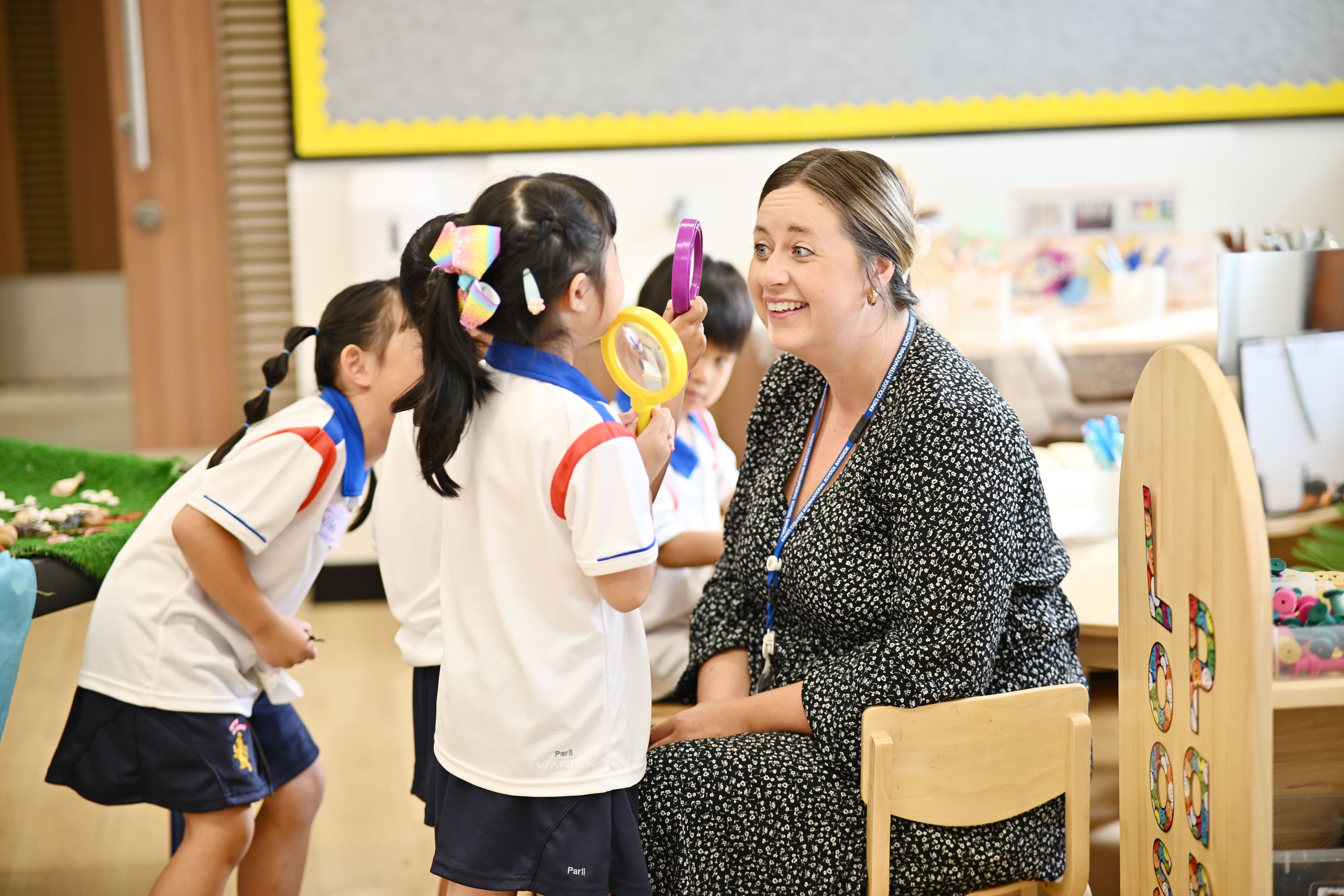
In EYFS, every classroom activity is carefully designed to stimulate specific developmental areas. When a 3-year-old child stacks wooden blocks into a tower, they are not just "playing" but simultaneously developing spatial thinking, hand-eye coordination, and problem-solving skills. And behind that activity is a teacher observing, noting, and ready to ask the right questions to extend the learning experience.
Ofsted, the UK's education inspection body, clearly affirms: "teaching" and "play" are not two separate things. During early years inspections, Ofsted inspectors spend most of their time watching children play, in order to judge the quality of interaction and teaching.
4 Foundational Principles of EYFS
Before looking at what children learn, it helps to understand what EYFS believes about children. According to the EYFS Statutory Framework, the entire programme is built on 4 core principles:

These four principles explain why when entering a good EYFS classroom, you will see a space that looks "free": children move between activity areas, choosing what they want to explore. Yet behind that freedom lies careful intention - in how the areas are arranged, the materials set out, and the way teachers question and respond to each child.
The "Positive Relationships" principle is further reinforced by Harvard research: "serve and return" interactions, where adults respond to a child's signals (eye contact, gestures, sounds) consistently and warmly, are the key factor in building healthy brain architecture in the early years.
The 7 Areas of Development in EYFS: What do children learn?
EYFS organises children's entire learning and development into 7 areas, divided into two groups with a clear order of priority.
Three Prime Areas
These are the three most important areas, developed first and forming the foundation for all later learning.
1. Communication and Language
Children learn to listen, understand language and put their thoughts into words. In an EYFS classroom, this happens most naturally: through storytelling, brief conversations between teachers and children, and a child telling a friend what they just built. For children in international schools, this is also the most natural way to acquire English, not by "learning vocabulary" but by living in that language every day. EEF research shows that the quality of language interaction between adults and children - not the amount of vocabulary taught - is the strongest predictor of language development in early childhood.
2. Physical Development
This is about far more than running and jumping. It covers both gross motor skills (climbing, balancing, coordination) and fine motor skills (holding a pen, tearing paper, using scissors, threading beads). These small skills are the direct foundation for writing, drawing and self-care later on.
3. Personal, Social and Emotional Development (PSED)
This is the area EYFS emphasises most, and one that many other early years programmes overlook. Children learn to recognise their emotions, calm themselves when upset or disappointed, make friends and take their place in a community. The philosophy of EYFS is very clear and supported by science. Research by the Harvard Center on the Developing Child confirms that the capacity for self-regulation formed during the early years is one of the strongest predictors of future academic and life success. A confident child who can manage their emotions learns better in any setting - from preschool to primary school and beyond.
Four Specific Areas
These four areas broaden and apply what the three prime areas have built.
4. Literacy
This is not about teaching children to read and write fluently, but about sowing a love of books and words - enjoying stories, hearing sounds and rhymes (phonics), and beginning to read and write, all at each child's own pace.
5. Mathematics
Children build early ideas about counting, comparing more and less, and recognising shapes and space - all through play and practical activities, not worksheets.
6. Understanding the World
Children explore nature, learn about their community, culture, and the people around them, and familiarise themselves with how things work. This is the foundation for future scientific and humanistic thinking.
7. Expressive Arts and Design
Painting, music, dance, storytelling and role play are all ways children express themselves and build their imagination. EYFS treats creativity not as a fixed talent, but as an ability to be nurtured from the earliest years.

Why is EYFS an important foundation for the entire learning journey?
You might be thinking: "My child is only 3 years old, why think so far ahead?" But science says you should.
According to research published by the Center on the Developing Child at Harvard University: in the first 5 years of life, a child's brain forms over 1 million new neural connections every second, faster than at any other stage in life. The process is like building a house: simpler connections form first, creating the frame for more complex circuits later. A solid foundation makes the whole structure strong; a weak one makes every later repair far more costly.
EYFS is designed to make the most of this golden period - not by cramming knowledge, but by creating a rich environment that offers exactly the experiences a young brain needs.
The Harvard Center on the Developing Child asserts: "Preventative intervention in the early years is significantly more effective than efforts to remediate developmental challenges at a later stage". In other words: this is the golden period for a child's development.
EYFS builds the foundation for Primary School and beyond. Children who enter Year 1 with a strong EYFS foundation - able to listen, focus, communicate confidently and work with others - have a clear advantage over those who have only memorised numbers and letters but are not yet ready emotionally and socially.
In the British curriculum, EYFS is the first step in a continuous academic journey: Early Years → Primary School → Secondary School (IGCSE) → Sixth Form (A levels) → University. Each stage builds seamlessly on the one before, and the EYFS foundation is where it all begins.
This journey is chosen by nearly 2 million pupils in 160 countries each year. According to a report by the Independent Schools Council (ISC), representing over 1,400 independent schools in the UK, the British curriculum continues to be one of the most trusted international education models in the world, with the Early Years (EYFS) foundation as the starting point for the entire pathway.
EYFS develops people, not just pupils. The PSED area, one of the 3 Prime Areas, is the clearest testament to this. Harvard research also emphasizes: cognitive, emotional, social, and language development are not separate systems but are deeply intertwined in the developing brain. EYFS is built on this exact principle: simultaneous, holistic, and unbiased development. EYFS holds that a happy, confident and empathetic child will be a better learner and, more importantly, a better adult.
EYFS at King's College Wimbledon Ho Chi Minh City - The early years deserve the very best
There are many ways to teach young children. But there is a real difference between following EYFS and truly living it.
At King's College Wimbledon Ho Chi Minh City, the Early Years programme not only follows the UK's EYFS framework but is also integrated with the King's Excellence philosophy: educating the Mind, Spirit, and Heart. This means that, from preschool onwards, children develop not only academically but also in curiosity, patience and empathy - qualities that stay with them for life.
The classroom space is designed exactly according to the Enabling Environments principle of EYFS, with diverse activity areas: a reading corner, a mini science corner, an art corner, a role-play corner, and a safe outdoor space for children to run, climb, and explore nature. Every corner of the classroom has a purpose; nothing is left to chance.
Each child has a personal development record that teachers keep up to date, noting small daily steps: today they fed themselves, this week they told a short story, this month they learned to wait their turn. This is central to EYFS: knowing each child as an individual, rather than judging them against a single measure. This continuous observation-based assessment method is exactly what Ofsted recommends.
The Early Years teaching team at King's College Wimbledon Ho Chi Minh City is selected according to British teacher standards, with EYFS teaching experience at British curriculum international schools. They do not simply understand EYFS in theory; they live it daily - knowing when to observe, when to guide and when to step back so a child can explore for themselves.
King's College Wimbledon HCMC extends the educational excellence of King's College School, Wimbledon – founded in 1829 by Royal Charter and named the World's top 5 school (HSBC Hurun Education Global High Schools 2025). The ranking draw on exam results, university destinations, academic reputation and teaching quality
The academic excellence at King’s College School, Wimbledon is not just reputation; it is proven by concrete results: in the 2025 GCSE/IGCSE exams: 90.6% of all pupil exam grades achieved a 9 or 8 (equivalent to A* and A). The Junior School, including Early Years, is consistently rated "Excellent" across all criteria by the ISI (Independent Schools Inspectorate). The same standard and quality is being brought to King's College Wimbledon Ho Chi Minh City.

What do parents frequently ask about EYFS?
Yes. EYFS is built around the natural development of young children, whatever their nationality or language. Over 130 countries worldwide are implementing EYFS in international schools, with pupils from hundreds of different cultures. Vietnamese children in EYFS-applied schools adapt very quickly to the discovery-based learning environment, especially when this environment is correctly designed according to the "Enabling Environments" principle to stimulate the natural curiosity inherent in every child.
Not at all. EYFS is for children from birth to five, and ages three to four are among the richest for language and social development. According to Harvard research, the process of forming neural connections is most intense during the first 5 years of life, meaning 3 and a half is still right in the middle of the golden period. The EYFS environment offers exactly the kind of stimulation a child's brain needs at this age.
This is exactly what EYFS is designed to do. The programme concludes with the Reception stage (the final year of EYFS, ages 4-5), after which children naturally transition into Year 1 of Primary School. At the end of Reception, teachers conduct the EYFS Profile assessment: evaluating the child's development against 17 Early Learning Goals across the 7 areas, helping Year 1 teachers clearly understand each pupil from day one.
Scientific research on bilingualism in young children has clearly shown: children are completely capable of processing two (or more) languages simultaneously during their early years without getting "confused". In fact, neurological research indicates that bilingual children often develop better cognitive flexibility and metalinguistic awareness. The important thing is: the language environment at school needs to be consistent, rich, and natural. And this is exactly what EYFS provides.
EYFS: Where all great journeys begin
If someone asks you what EYFS is, you need no complex definition. You can put it simply:
EYFS is how the British think about a child's early years - a stage so important that it deserves a national framework to make sure every child is cared for, valued and properly supported to develop.
There are no tests, no rankings, no pressure to perform - just a child growing a little each day: learning to listen, to express themselves, to make friends, and to love learning, in an environment carefully designed to protect and nurture exactly what they need.
And it is exactly the foundation built in those most innocent years that will help them confidently step into Primary School, and one day progress to IGCSE and A levels with genuine readiness—not just in knowledge, but in resilience, mindset, and character.
References:
Early Years Foundation Stage Statutory Framework
Ofsted Early Years Inspection Handbook
Early Years Evidence Store — Play-Based Learning
Ofsted — Teaching and Play in the Early Years
The Science of Early Childhood Development
King's College School, Wimbledon — Junior School
Cambridge International — Annual Statistics & Global Network
HSBC Hurun Education Global High Schools 2025
Want to discover more about King's College Wimbledon HCMC?
Are you looking to learn more about EYFS at King's College Wimbledon Ho Chi Minh City? Book a school tour to meet the Early Years team, explore the School Gallery space, and ask any questions about your child's early years journey.
Book a school tour now